

PSA Screening For Prostate Cancer: An Infographic
Maybe THIS is why nobody puts the information all in one place...

Last week on the podcast I talked about Tuesday’s publication of the 23-year follow-up results from the largest ever trial of prostate-specific antigen (‘PSA’) screening, with 150,000 men. The findings are, I think, jaw-dropping.
The most important thing about info like this, IMO, is that it should be available and transparent. The decision about using the PSA blood test to screen for prostate cancer clearly comes down to personal values. Do you prize bodily autonomy most, and avoiding doctors? You might not want a PSA test. Do you seek peace of mind first and foremost, and therefore feel ok with possible false positive results? Then you might want a PSA. Do you value quality over quantity of life? Perhaps a PSA is not for you. Do you feel you’d adjust well to a lower quality of life, and do you therefore prioritize any chance at a longer life? PSA might be for you.
Tricky, and personal. Here’s an infographic with broadly accepted estimates of benefits and harms from trial data and the USPSTF evidence review. There is nothing remotely controversial or new about these numbers. I’m simply putting them in one place. (And, to be conservative about my own skepticism, inflating the possibility of a benefit, despite there being no overall mortality benefit, and according to some authors no mortality benefit of any kind).
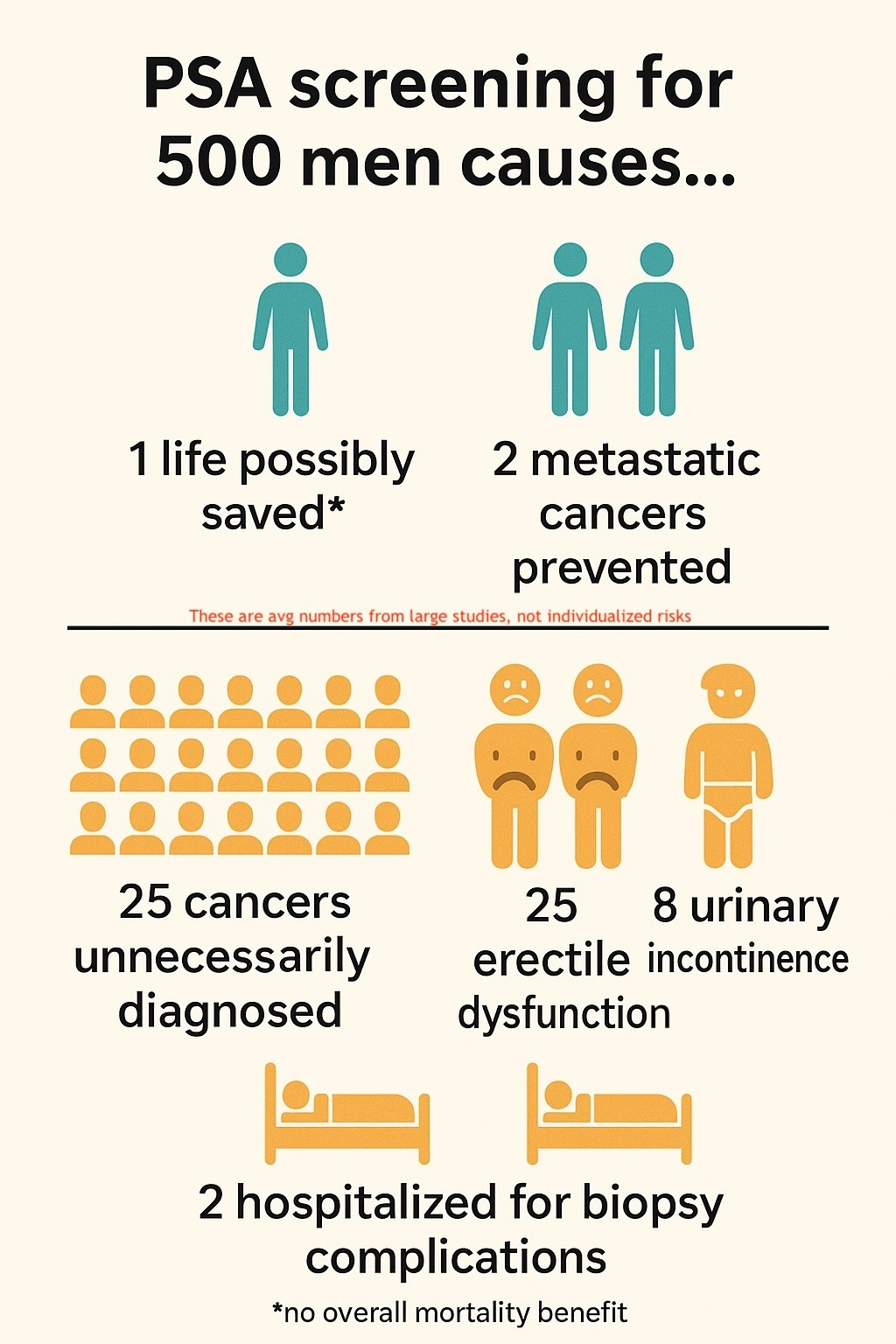
Seems to me many men would want to know that while PSA screening may save a life for 1 in every 500 men offered the test, it’s 25x more likely to make you impotent, 8x more likely to cause incontinence, and 25x more likely to cause an unnecessary cancer diagnosis (and any treatment that comes with it). If this fits your values and priorities, a PSA test may be right for you.
Another approach to this info was espoused by an editorial published alongside last week’s results in the New England Journal of Medicine. The author derided the notion of letting men make their own decisions, writing “we have to do better than abdicate the responsibility for PSA decision making to individual patients and instead formulate policies on PSA screening that maximize benefits and minimize harms.”
That whole informed consent thing—it’s so messy. Better if we choose for you, sir!
For clinicians and anyone else who wants to see the breakdown for these numbers, you can check out the document attached.

[Note: ChatGPT helped me build both of these documents, and Chat has to be very closely watched with numbers like this. I think I checked it all and it looks on target (i.e. the USPSTF’s data is correctly transcribed here), but if you see something you think is wrong, let me know and I’ll recheck.]
Interesting read
Here is my take on the biggest gap on PSA evidence
https://open.substack.com/pub/vageeshjain/p/prostate-cancer-screening-low-value?r=5ivr8m&utm_medium=ios
David: Thank you for this article. It helped me clarify the risks and benefits of PSA screening and confirmed what I’d suspected but hadn’t taken the time to sort out. Now I can worry about other things.